


A potential customer clicks on your Shopify store link, waits 4 seconds for it to load, gets frustrated, and bounces back to Google to find your competitor instead. Sound familiar? You’ve just lost a sale, and Google’s algorithm noticed that bounce too.
As someone who’s spent 8 years optimizing e-commerce websites and providing professional Shopify SEO services, I’ve seen countless store owners struggle with site speed issues that directly impact their search rankings. The good news? Shopify’s built-in Content Delivery Network (CDN) powered by Fastly is one of your most powerful SEO weapons – and most entrepreneurs don’t even know they have it.
In this comprehensive guide, I’ll walk you through exactly how to leverage Shopify’s CDN infrastructure to boost your search engine rankings, improve user experience, and ultimately drive more sales to your store. Whether you’re running SEO Services for clients or optimizing your own e-commerce empire, understanding CDN optimization is crucial for modern Ecommerce SEO success.
What Exactly is Shopify’s CDN and Why Should You Care?
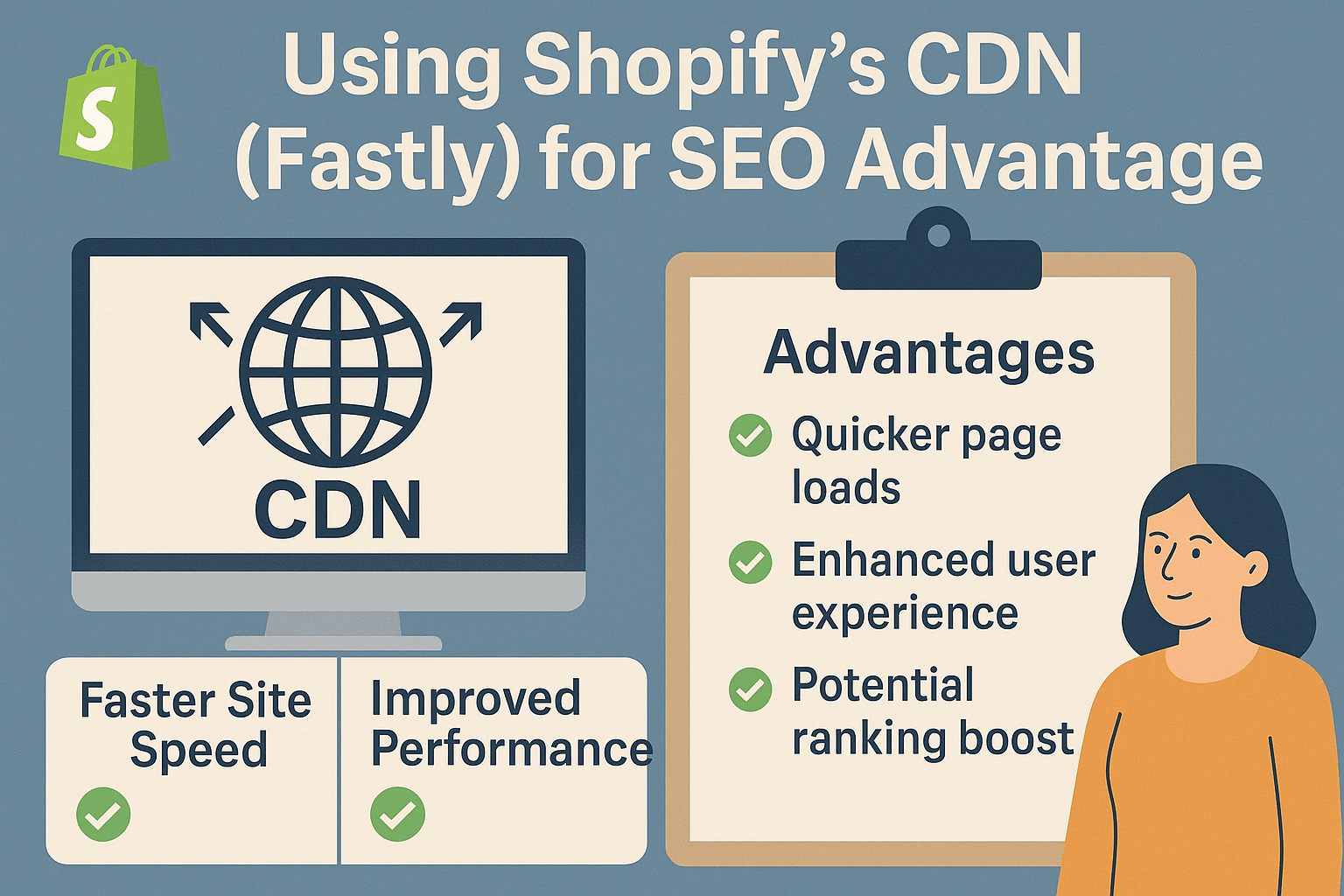
Shopify’s Content Delivery Network, powered by Fastly, is a globally distributed network of servers that automatically delivers your store’s content from the server closest to your visitors. Think of it as having mini-versions of your store strategically placed around the world, ready to serve customers instantly.
Here’s what makes this powerful: When someone in Tokyo visits your store based in New York, instead of their request traveling thousands of miles to your origin server, Shopify’s CDN serves the content from a server in Japan. This dramatically reduces load times from potentially 3-4 seconds down to under 1 second.
Google’s Core Web Vitals update made site speed a direct ranking factor, meaning faster sites literally rank higher in search results. According to Google’s research, the probability of bounce increases by 32% when page load time goes from 1 to 3 seconds, and by 90% when it goes from 1 to 5 seconds.
How Does Fastly’s CDN Network Actually Improve Your SEO Rankings?
The connection between CDN performance and SEO success runs deeper than most store owners realize. When conducting an SEO Audit for Shopify stores, I consistently find that the fastest-loading stores also tend to rank highest in search results.
Fastly operates over 200 global edge locations, meaning your Shopify store content is cached and served from servers strategically positioned worldwide. This geographic distribution directly impacts three critical SEO factors: page load speed, user experience signals, and crawl efficiency.
Search engines like Google use page speed as a ranking factor because it correlates strongly with user satisfaction. When your store loads in under 2 seconds thanks to CDN optimization, visitors stay longer, view more pages, and complete more purchases. These positive user signals tell Google that your site provides value, leading to improved rankings.
Additionally, faster sites enable search engine crawlers to index more of your pages within their allocated crawl budget. This means better coverage of your product pages, category pages, and blog content in search results.
What Performance Metrics Should You Monitor for SEO Success?
Understanding the right metrics helps you measure your CDN’s impact on SEO performance. Focus on these key indicators that directly influence your search rankings:
Core Web Vitals represent Google’s official user experience metrics. Largest Contentful Paint (LCP) should be under 2.5 seconds, First Input Delay (FID) under 100 milliseconds, and Cumulative Layout Shift (CLS) under 0.1. Shopify’s CDN typically helps achieve these benchmarks when properly optimized.
Time to First Byte (TTFB) measures server response time and should ideally be under 200 milliseconds. Fastly’s edge servers excel at reducing TTFB by serving cached content from locations closer to your visitors.
Bounce rate and session duration provide indirect SEO signals. Faster-loading stores typically see bounce rates decrease by 20-40% and session duration increase by 15-30%, both positive ranking factors.
Monitor these metrics using Google PageSpeed Insights, GTmetrix, or Google Search Console’s Core Web Vitals report. Set up regular monitoring to track improvements and identify optimization opportunities.
How Can You Optimize Images for Maximum CDN Performance?
Image optimization represents the biggest opportunity for CDN performance improvements in most Shopify stores. Unoptimized images account for 60-80% of page weight in typical e-commerce sites, directly impacting load times and SEO performance.
Shopify’s CDN automatically serves images in next-gen formats like WebP when browsers support them, reducing file sizes by 25-35% compared to traditional JPEG images. However, you need to upload high-quality source images for the CDN to work with.
Start by ensuring all product images are properly compressed before uploading. Aim for file sizes under 100KB for product thumbnails and under 300KB for hero images. Use descriptive, keyword-rich filenames that support your On Page SEO strategy – instead of “IMG_1234.jpg,” use “red-leather-handbag-womens-fashion.jpg.”
Implement proper alt text for all images, incorporating relevant keywords naturally while describing the image content. This supports both accessibility and Semantic SEO efforts while helping search engines understand your visual content.
Consider using Shopify’s responsive image features, which automatically serve appropriately sized images based on device and screen resolution. This reduces unnecessary data transfer and improves Core Web Vitals scores.
Which Caching Strategies Work Best with Shopify’s CDN?
Shopify handles most caching automatically, but understanding how it works helps you optimize your store’s performance. The platform caches static assets like images, CSS, and JavaScript files at edge locations, while dynamic content like product inventory and pricing updates in real-time.
Browser caching works alongside CDN caching to store resources locally on visitors’ devices. Shopify automatically sets appropriate cache headers, but you can optimize by minimizing cache-busting changes to CSS and JavaScript files.
For stores with frequently changing inventory, Shopify’s intelligent caching system updates product availability across the CDN network within seconds, ensuring customers always see accurate information while maintaining fast load times.
Consider how your theme modifications might impact caching efficiency. Inline CSS and JavaScript reduce cacheability, while external files benefit from CDN acceleration. Clean, well-structured themes perform better with CDN caching than heavily customized ones with multiple third-party integrations.
Why Does Geographic Distribution Matter for Local SEO?
Local SEO benefits significantly from CDN optimization, especially for stores serving multiple geographic markets. When your store loads quickly for users in different regions, you improve the user experience signals that Google considers for local search rankings.
Fastly’s global network includes edge servers in major metropolitan areas, directly benefiting stores targeting local markets. A restaurant supply store in Chicago serving the Midwest will benefit from edge servers in nearby cities, while an international fashion brand needs global coverage for optimal performance.
Page speed becomes even more critical for mobile local searches, where users expect instant results. CDN optimization ensures your store loads quickly regardless of whether customers find you through “near me” searches or targeted local keywords.
Consider creating location-specific landing pages that benefit from CDN acceleration. These pages load quickly for local searchers while supporting your broader local SEO strategy through improved user experience signals.
What Advanced CDN Features Can Boost Your SEO Performance?
Shopify’s Fastly-powered CDN includes several advanced features that directly impact SEO performance beyond basic content acceleration. Understanding these features helps you maximize your store’s search engine potential.
HTTP/2 support enables multiplexing, allowing browsers to download multiple resources simultaneously rather than sequentially. This feature reduces perceived load times and improves Core Web Vitals scores, particularly for stores with multiple images and resources per page.
Real-time purging ensures updated content reaches customers instantly while maintaining cache efficiency. When you update product descriptions, prices, or inventory levels, changes propagate across the CDN network within seconds, eliminating concerns about serving stale content to search engine crawlers.
Security features including DDoS protection and SSL/TLS termination at edge servers improve both user trust and search engine confidence in your site. Google considers site security a ranking factor, making these features valuable for SEO beyond their obvious security benefits.
Analytics and monitoring capabilities help you identify performance bottlenecks and optimization opportunities. Use these insights to refine your SEO strategy and identify which pages or resources need additional optimization attention.
How Should You Measure CDN Impact on Your SEO Results?
Tracking the right metrics helps you understand how CDN optimization translates into SEO improvements and business results. Focus on both technical performance indicators and business outcomes to get a complete picture.
Search engine rankings for your target keywords should improve as site speed increases. Track rankings for your most important product categories and brand terms, looking for correlation between faster load times and higher positions.
Organic traffic growth often follows CDN optimization, particularly for long-tail keywords and product-specific searches. Monitor organic sessions, page views, and conversion rates to measure the business impact of performance improvements.
Search Console data provides insights into how Google perceives your site’s performance. Monitor the Core Web Vitals report for improvements in LCP, FID, and CLS scores, and watch for increases in indexed pages as faster crawling enables better coverage.
Set up conversion tracking to measure how performance improvements translate into business results. Faster-loading stores typically see 10-20% improvements in conversion rates, directly impacting revenue and ROI from your SEO efforts.
What Common CDN Optimization Mistakes Should You Avoid?
Even with Shopify’s automated CDN management, several common mistakes can limit your SEO benefits and performance gains. Avoiding these pitfalls ensures you maximize your store’s search engine potential.
Over-customization of themes often introduces performance bottlenecks that CDN acceleration cannot overcome. Excessive third-party apps, poorly optimized custom code, and inline styling reduce cache efficiency and slow load times despite CDN benefits.
Ignoring mobile optimization limits CDN effectiveness, particularly since mobile users represent 60-70% of e-commerce traffic. Ensure your theme performs well on mobile devices and takes advantage of CDN acceleration for mobile-specific resources.
Neglecting regular performance audits means missing optimization opportunities and performance regressions. Schedule monthly reviews of your Core Web Vitals scores, page load times, and search engine rankings to maintain optimal performance.
Focusing solely on speed while ignoring content quality limits SEO success. CDN optimization should support high-quality, relevant content that serves user intent, not replace comprehensive SEO strategy including keyword research, content creation, and link building.
Action Points for Implementing Your CDN SEO Strategy
Ready to leverage Shopify’s CDN for better search engine rankings? Start with these immediate action items that deliver measurable results:
Audit your current performance using Google PageSpeed Insights and Core Web Vitals reports. Document your baseline scores for LCP, FID, and CLS to measure improvement over time.
Optimize all product images by compressing files, using descriptive filenames, and implementing proper alt text. This single change often delivers the biggest performance improvement for most Shopify stores.
Review your theme performance and eliminate unnecessary customizations that might interfere with CDN caching. Consider switching to a faster, more optimized theme if performance issues persist.
Set up monitoring systems to track your progress and identify new optimization opportunities. Use tools like Google Analytics, Search Console, and third-party performance monitoring to maintain visibility into your store’s performance.
Plan regular optimization reviews to maintain and improve performance over time. SEO and performance optimization require ongoing attention, not one-time fixes.
Your Next Steps Toward CDN-Powered SEO Success
Shopify’s Fastly-powered CDN represents a significant competitive advantage for store owners who understand how to leverage it effectively. The combination of global distribution, intelligent caching, and automatic optimization provides a solid foundation for SEO success, but maximizing these benefits requires strategic thinking and consistent optimization.
Remember that CDN optimization works best as part of a comprehensive SEO strategy that includes quality content, proper technical implementation, and ongoing performance monitoring. The stores that see the biggest SEO improvements combine fast loading times with relevant, valuable content that serves user intent.
As search engines continue emphasizing user experience signals and Core Web Vitals, the importance of CDN optimization will only increase. Store owners who master these concepts now position themselves for long-term SEO success and sustainable business growth.
Start implementing these strategies today, and you’ll begin seeing improvements in search rankings, user engagement, and conversion rates within weeks. Your customers will notice the difference, Google will reward the performance, and your business will benefit from the increased visibility and sales that follow.