

You’re running a successful Shopify store selling handmade jewelry, but 67% of your potential customers can’t find you because they’re searching in Spanish, French, or German. Meanwhile, your competitor just expanded internationally and saw a 340% increase in sales within six months. The difference? They cracked the code on multilingual Shopify SEO.
If you’re a small business owner or entrepreneur ready to tap into the $4.9 trillion global e-commerce market, you’re in the right place. After helping hundreds of Shopify stores expand internationally over my 8 years in the SEO services industry, I’ve seen firsthand how proper multilingual SEO setup can transform a local business into a global powerhouse.
Here’s the reality: 75% of consumers prefer buying products in their native language, and 60% rarely or never buy from English-only websites. This comprehensive guide will walk you through every technical step needed to set up multilingual Shopify SEO that actually converts international visitors into paying customers.
Why Multilingual SEO Matters More Than Ever in 2025
The numbers don’t lie. Businesses with multilingual websites generate 20% more revenue per visitor compared to monolingual sites. When ASOS implemented proper multilingual SEO across 12 languages, they saw a 156% increase in organic traffic from non-English speaking countries within the first year.
Your Shopify store isn’t just competing locally anymore. Every day, potential customers in France, Germany, Spain, and dozens of other countries are searching for products you sell. Without proper multilingual SEO infrastructure, you’re invisible to them. The good news? Most of your competitors haven’t figured this out yet, giving you a massive first-mover advantage.
Modern ecommerce SEO isn’t just about translating content anymore. It requires understanding cultural nuances, local search behaviors, and technical implementations that make search engines trust your international presence. This is where strategic multilingual SEO becomes your competitive weapon.
How Does Multilingual SEO Impact Your Bottom Line?
When Gymshark expanded beyond English-speaking markets with proper multilingual SEO, their international revenue jumped from 23% to 67% of total sales within 18 months. Here’s why multilingual SEO delivers such dramatic results:
Search engines treat each language version as a separate entity, essentially multiplying your organic reach. A single product optimized in English, Spanish, and French can rank in three different search ecosystems simultaneously. This means triple the visibility, triple the traffic opportunities, and ultimately, triple the revenue potential.
The technical setup process I’m about to share addresses the most common multilingual SEO mistakes that cost businesses millions in lost revenue. Poor hreflang implementation alone can reduce international organic traffic by up to 45%, while incorrect URL structures confuse both users and search engines.
What Are Your Shopify Multilingual Options?
Shopify offers several approaches for multilingual implementation, each with distinct SEO implications. The native Shopify Markets feature supports basic translation but often falls short for serious SEO optimization. Third-party apps like Weglot, Langify, and GTranslate offer more robust solutions, though each requires specific technical configurations.
The key decision point revolves around URL structure. Subdirectories (yourstore.com/es/) generally perform better for SEO than subdomains (es.yourstore.com) because they consolidate domain authority. However, ccTLDs (yourstore.es) can dominate local search results if properly implemented.
Your choice impacts everything from crawl budget allocation to local SEO performance. Most successful Shopify stores I’ve worked with start with subdirectories for 2-3 languages, then expand to ccTLDs for their highest-performing international markets.
Technical Foundation: URL Structure and Hreflang Implementation
Your URL structure forms the backbone of multilingual SEO success. Search engines need clear signals about which content serves which audience. The subdirectory approach (yourstore.com/en/, yourstore.com/es/) offers the best balance of SEO power and technical simplicity for most Shopify stores.
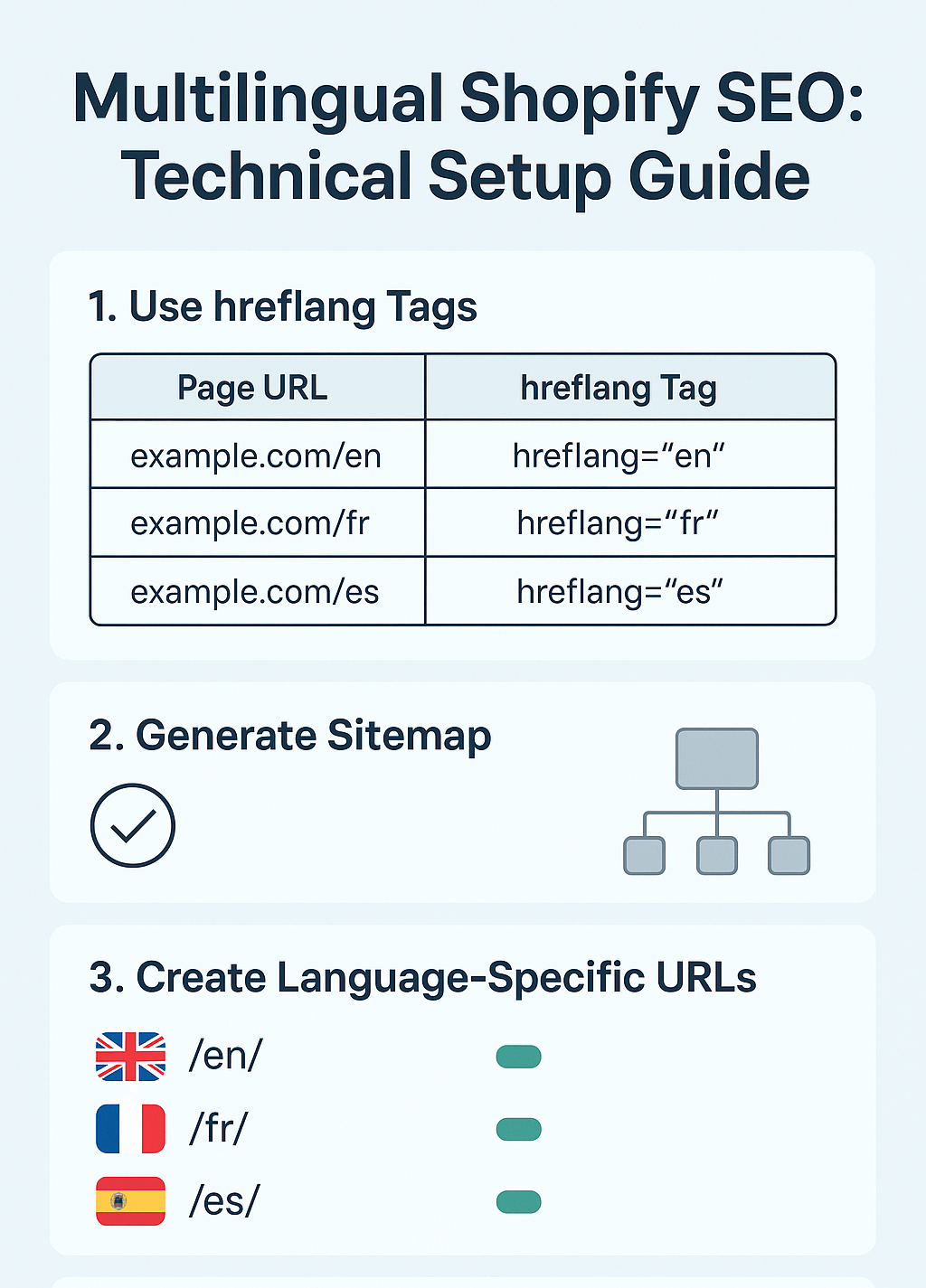
Hreflang tags tell search engines which language version to show specific users. Incorrect implementation causes duplicate content issues and confused search results. Here’s the critical technical setup:
Each page must include hreflang tags for every language version, including a self-referencing tag. The x-default tag should point to your primary market version. For a US-based store with Spanish support, your English product page needs: hreflang=”en-us”, hreflang=”es”, and hreflang=”x-default” tags properly configured.
Action Point: Audit your current hreflang implementation using Google Search Console’s International Targeting report. Common errors include missing return tags, incorrect language codes, and orphaned pages without proper cross-references.
Content Translation vs. Localization: The SEO Difference
Translation converts text from one language to another. Localization adapts content for specific markets, considering cultural preferences, local search behaviors, and regional business practices. For SEO purposes, localization wins every time.
Spanish speakers in Mexico search differently than Spanish speakers in Spain. “Zapatos deportivos” might be popular in Mexico while “zapatillas deportivas” dominates Spanish searches. This keyword variation can impact your organic visibility by 200-300% in specific markets.
Professional localization goes beyond keywords. It adapts product descriptions, calls-to-action, shipping information, and trust signals for local preferences. When H&M localized their Shopify content for Japanese markets, they saw 280% higher engagement rates compared to direct translations.
Action Point: Conduct keyword research in each target language using native-speaking SEO professionals or tools like SEMrush’s regional databases. Don’t rely solely on translation tools for keyword strategy.
On-Page SEO for Multilingual Shopify Stores
Each language version requires complete on-page SEO optimization. Title tags, meta descriptions, header structures, and internal linking must be optimized in the target language using locally relevant keywords. This isn’t just translation—it’s rebuilding your SEO foundation for each market.
Product descriptions need cultural adaptation beyond language. German customers expect detailed technical specifications, while Italian shoppers respond better to lifestyle-focused descriptions. These preferences directly impact time-on-page metrics and conversion rates, which influence SEO rankings.
Internal linking becomes complex in multilingual setups. Each language version should primarily link to pages in the same language, while strategic cross-language linking can boost domain authority distribution. Category pages in Spanish should predominantly link to Spanish product pages, maintaining language consistency for better user experience.
Image alt text, product schema markup, and FAQ sections require full localization. Google’s algorithm increasingly considers user experience signals, making culturally appropriate content crucial for ranking success.
Action Point: Create language-specific content calendars that address local holidays, seasonal trends, and cultural events relevant to each target market.
Technical SEO Configurations for International Success
XML sitemaps need separate organization for multilingual content. Submit language-specific sitemaps to Google Search Console for each target country. This helps search engines understand your content structure and improves indexing efficiency for international pages.
Page speed optimization becomes critical as international users often have slower internet connections. Compress images more aggressively for developing markets, and consider regional CDN distribution to reduce load times across different geographical areas.
Mobile optimization takes on new importance in international markets. Some countries have mobile usage rates exceeding 80%, making mobile-first design essential for SEO success. Your multilingual Shopify theme must perform flawlessly across devices and connection speeds.
Structured data markup requires localization for each language version. Product schema, review markup, and local business schema should reflect local formatting standards, currencies, and business information relevant to each market.
Action Point: Use Google’s Rich Results Test tool to validate structured data for each language version, ensuring local currency and formatting standards are correctly implemented.
Local SEO Integration for Global Shopify Success
Local SEO becomes crucial when expanding internationally, even for e-commerce businesses. Creating Google My Business listings in target countries, obtaining local citations, and building relationships with regional influencers significantly boost organic visibility in local search results.
Time zone considerations affect both SEO and user experience. Your multilingual Shopify store should display local business hours, shipping timeframes in local business days, and customer service availability that matches regional expectations.
Cultural trust signals vary dramatically between markets. European customers expect detailed privacy policies and GDPR compliance, while American shoppers prioritize return policies and customer reviews. These elements directly impact bounce rates and conversion signals that influence SEO performance.
Regional payment methods and shipping options should be prominently featured in local language versions. Shoppers in Germany expect SEPA transfers, while Brazilian customers prefer Boleto payments. These preferences affect user engagement metrics that search engines monitor.
Action Point: Research local competitors in each target market to understand regional SEO best practices, preferred trust signals, and common user experience patterns.
Measuring Multilingual SEO Success
Track performance metrics separately for each language version using Google Analytics 4’s enhanced measurement capabilities. Set up custom segments for each market to monitor organic traffic, conversion rates, and user engagement patterns across different languages.
Search Console provides invaluable insights into multilingual performance through country and language filtering. Monitor click-through rates, average positions, and impressions for each market separately to identify optimization opportunities.
Revenue attribution becomes complex in multilingual setups. Implement proper UTM tracking for organic traffic from different countries and languages. This data helps prioritize which markets deserve additional SEO investment and content development.
Regular SEO audits should include language-specific analysis. Technical issues like broken hreflang tags, missing translations, or cultural content mismatches can severely impact international organic performance.
Action Point: Create monthly SEO audit checklists that include multilingual-specific elements like hreflang validation, translation quality assessment, and local keyword ranking monitoring.
Common Multilingual SEO Mistakes to Avoid
Automatic translation tools create content that search engines can identify as low-quality, hurting your rankings across all language versions. Google’s algorithm has become sophisticated at detecting machine-translated content, often penalizing sites that rely heavily on automated translation.
Duplicate content issues frequently arise when businesses translate content without proper localization. Search engines may view different language versions as duplicate content if they’re too similar in structure and don’t provide unique value for local users.
Neglecting mobile optimization for international markets causes massive SEO losses. Countries like India and Brazil have mobile usage rates above 85%, making mobile performance crucial for organic visibility in these markets.
Currency and pricing display errors confuse both users and search engines. Displaying USD prices to European visitors creates trust issues and increases bounce rates, negatively impacting your SEO performance in those markets.
Action Point: Implement regular quality assurance checks for each language version, focusing on cultural appropriateness, technical functionality, and user experience consistency.
Advanced Multilingual SEO Strategies
Semantic SEO becomes even more powerful in multilingual contexts. Understanding related terms, synonyms, and contextual language usage in each target market helps create content that ranks for broader keyword families and captures more organic traffic.
Content clustering strategies should reflect local search behaviors. German users might search for “Winterstiefel” while Americans search for “winter boots,” but the related semantic keywords vary significantly between markets. Building topic clusters around locally relevant terms improves overall domain authority for each language version.
International link building requires cultural sensitivity and local relationship development. Earning backlinks from respected German websites carries more weight for your German language pages than links from American sites, even if the American sites have higher domain authority.
User-generated content like reviews and Q&A sections should be managed separately for each language version. Encourage customers to leave reviews in their native language, as this content provides fresh, locally relevant keywords that boost SEO performance.
Action Point: Develop market-specific content strategies that address unique local challenges, seasonal patterns, and cultural preferences for each target market.
Ready to Dominate Global Markets?
Implementing multilingual Shopify SEO isn’t just about translation—it’s about creating genuinely valuable experiences for customers in their preferred languages and cultural contexts. The businesses that get this right don’t just increase traffic; they build lasting international customer relationships that drive sustainable growth.
The technical foundation we’ve covered forms the backbone of successful international expansion. From proper hreflang implementation to culturally adapted content strategies, each element works together to signal trustworthiness and relevance to both search engines and international customers.
Your next step is choosing which markets to prioritize based on search volume, competition levels, and business potential. Start with one or two languages, perfect your technical setup, then expand systematically. The stores that rush into multiple markets simultaneously often struggle with quality control and miss opportunities for optimization.
Remember, multilingual SEO is a long-term investment that compounds over time. The international organic traffic you build today becomes the foundation for sustained global growth, reduced customer acquisition costs, and increased market share across multiple countries.
Final Action Point: Begin with a comprehensive SEO audit of your current Shopify setup, identify your highest-potential international markets, and create a phased implementation plan for multilingual expansion. The global market is waiting—and your properly optimized multilingual Shopify store will be ready to capture it.