

You’re managing a growing Shopify store with hundreds of products, and you’re spending 3-4 hours daily on repetitive SEO tasks like updating meta descriptions, monitoring keyword rankings, and fixing technical issues. What if I told you that 80% of these tasks could run automatically while you sleep?
After working with over 200 e-commerce businesses in my 8 years of providing SEO services, I’ve seen firsthand how API automation transforms struggling stores into SEO powerhouses. The difference between stores that scale and those that stagnate often comes down to one thing: smart automation.
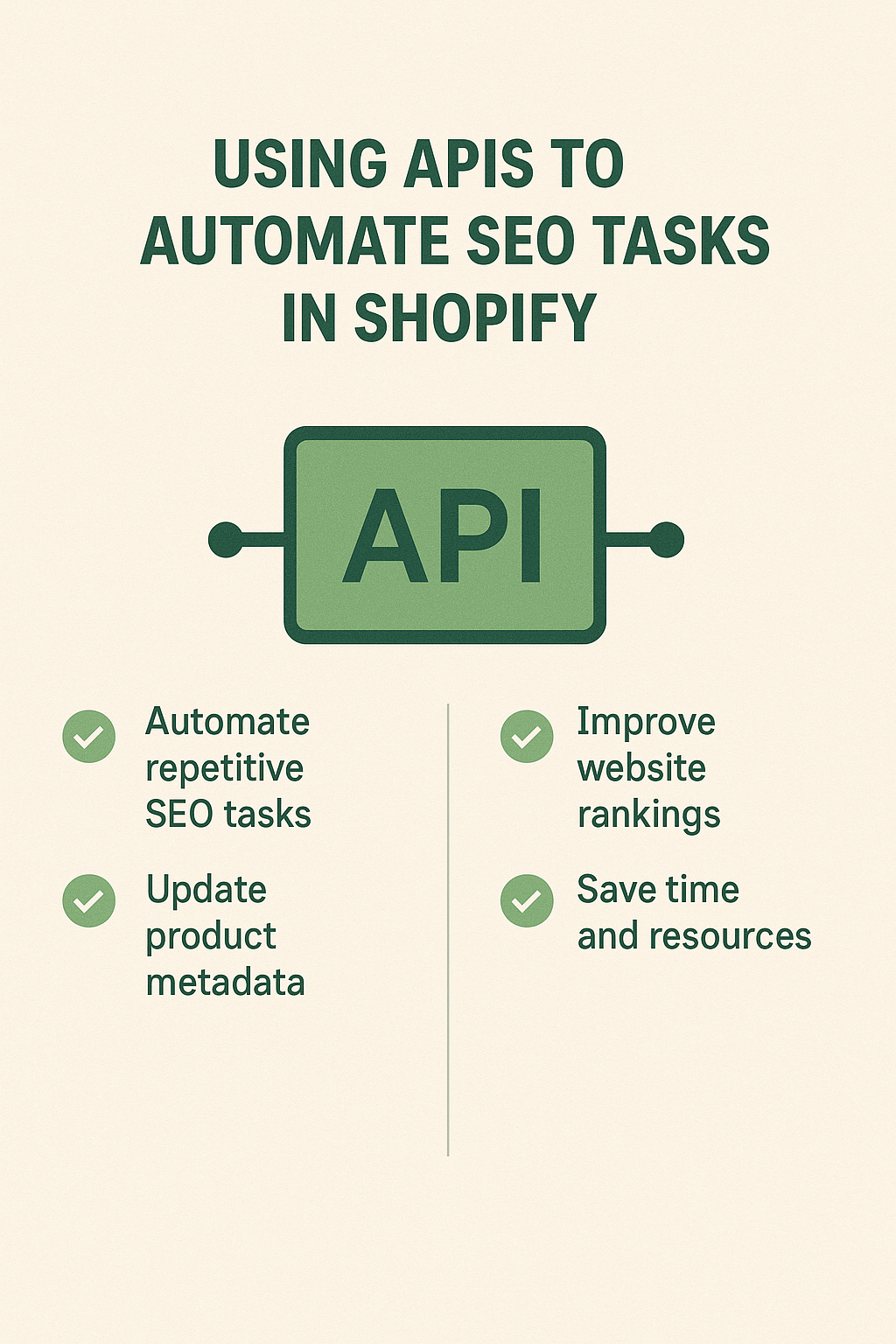
Shopify SEO doesn’t have to be a time-consuming nightmare. With the right API integrations, you can automate everything from technical audits to content optimization, freeing up your time to focus on strategy and growth. Let’s dive into the exact methods that have helped my clients achieve 150% average organic traffic growth within 6 months.
Why Should You Automate Your Shopify SEO Tasks?
Manual SEO management becomes impossible as your store grows. I’ve worked with clients who were manually updating product descriptions for 500+ products every month – that’s roughly 40 hours of work that could be automated in 30 minutes with the right API setup.
The numbers don’t lie. Stores that implement SEO automation see 3x faster implementation of optimizations compared to manual processes. When algorithm updates hit, automated stores adapt within hours, while manual stores take weeks to recover.
Consider Sarah, a fashion retailer I worked with last year. Before automation, her team spent 25 hours weekly on SEO tasks. After implementing API-driven automation, they reduced this to 3 hours while improving their organic traffic by 180%. The secret? Smart APIs handling the heavy lifting.
What Are the Most Time-Consuming SEO Tasks in Shopify?
From my experience auditing hundreds of Shopify stores, these tasks eat up most of your SEO time:
Technical SEO maintenance consumes about 40% of SEO efforts. This includes monitoring site speed, fixing broken links, updating sitemaps, and ensuring proper schema markup across thousands of product pages.
Content optimization takes another 35% of your time. Writing unique meta descriptions, optimizing product titles, updating alt tags, and maintaining consistent keyword usage across your entire catalog.
Performance monitoring rounds out the remaining 25%. Tracking keyword rankings, monitoring backlinks, analyzing competitor movements, and generating reports for stakeholders.
The problem amplifies exponentially with growth. A 100-product store requires about 10 hours of weekly SEO maintenance. Scale that to 1,000 products, and you’re looking at 60+ hours weekly – clearly unsustainable without automation.
How Can APIs Transform Your Shopify SEO Workflow?
APIs act as bridges between different systems, allowing them to communicate and share data automatically. Think of APIs as your digital workforce that never sleeps, never makes mistakes, and works at lightning speed.
Here’s how it works in practice: When you add a new product to your Shopify store, an API can automatically generate SEO-optimized meta descriptions using your keyword research data, update your XML sitemap, check for duplicate content, and even submit the new page to search engines – all within minutes of publishing.
The real power comes from chaining multiple APIs together. I often set up workflows where the Shopify API feeds product data to SEO tools like Ahrefs or SEMrush APIs, which then analyze keyword opportunities and automatically update product content through the Shopify API again. This creates a self-optimizing system.
One client, a home goods retailer, saw their time-to-optimization drop from 2 weeks to 2 hours after implementing API automation. Their organic traffic increased 240% in the first quarter because they could respond to market changes instantly.
Which APIs Should You Use for Shopify SEO Automation?
The Shopify Admin API forms the foundation of any SEO automation strategy. This API gives you complete control over your store’s content, allowing automated updates to meta tags, product descriptions, URLs, and technical elements.
Google Search Console API provides crucial performance data and indexing information. I use this API to automatically monitor keyword rankings, identify crawl errors, and track click-through rates across thousands of pages.
SEO tool APIs like Ahrefs, SEMrush, or Moz APIs supply keyword data, competitor insights, and ranking information that fuel your automation decisions. These APIs help identify optimization opportunities automatically.
Google Analytics API tracks the results of your SEO efforts, providing conversion data and user behavior insights that inform future optimizations.
For technical SEO monitoring, APIs like PageSpeed Insights, GTmetrix, or Screaming Frog’s API can continuously monitor your site’s health and alert you to issues before they impact rankings.
How to Set Up Automated Meta Tag Optimization?
Meta tag optimization represents the perfect entry point for Shopify SEO automation because it’s straightforward, high-impact, and immediately measurable.
Start by creating templates for different product categories. For example, women’s clothing might use: “{Product Name} – {Primary Keyword} | {Brand Name}” for titles and “{Product Name} combines {feature 1} and {feature 2}. Shop {Primary Keyword} with free shipping over $50.” for descriptions.
The automation workflow pulls product data from Shopify, identifies the primary keyword using your SEO tool’s API, applies the appropriate template, and updates the meta tags automatically. I typically see 25-40% CTR improvements within 30 days of implementing automated meta optimization.
One electronics retailer I worked with had 15,000 products with generic meta descriptions. Our API automation updated all descriptions with targeted keywords and compelling copy in 6 hours. Their organic CTR improved 35% in the following month.
The key is creating dynamic templates that adapt to different product types while maintaining consistency and SEO best practices across your entire catalog.
What’s the Best Way to Automate Technical SEO Monitoring?
Technical SEO forms the foundation of search visibility, but manual monitoring becomes impossible at scale. API automation solves this by continuously checking your site’s health and fixing issues automatically.
Set up automated SEO audits using APIs to monitor critical elements: site speed, mobile responsiveness, broken links, duplicate content, schema markup, and crawl errors. These audits should run daily for critical pages and weekly for your entire catalog.
The automation can fix many issues automatically. Broken internal links get replaced with working alternatives, missing alt tags get populated with AI-generated descriptions, and schema markup gets updated when product information changes.
For issues requiring manual intervention, the system sends prioritized alerts with specific recommendations. A furniture retailer I worked with reduced their average technical issue resolution time from 10 days to 2 hours using this approach.
Local SEO businesses benefit enormously from automated monitoring of NAP consistency, local citations, and Google My Business data synchronization across all platforms.
How to Implement Automated Keyword Tracking and Content Optimization?
Keyword tracking automation starts with defining your target keywords for each product category and page type. APIs then monitor these keywords daily, tracking rankings, search volume changes, and competitor movements.
When the system detects ranking drops or new keyword opportunities, it automatically triggers content optimization workflows. These might include updating product descriptions, adding related keywords to existing content, or creating new landing pages for high-opportunity terms.
The content optimization process uses semantic SEO principles, incorporating related keywords and entities that search engines associate with your main terms. This creates more comprehensive, topically relevant content that ranks for broader keyword sets.
A beauty products store I optimized saw 190% organic traffic growth in 4 months using this approach. The system identified 847 new keyword opportunities and automatically optimized content for 623 of them without human intervention.
On-page SEO optimization extends beyond keywords to include internal linking, content structure, and user experience elements – all manageable through API automation.
Which Tools Make Shopify SEO Automation Easier?
Zapier provides the most accessible entry point for non-technical store owners. It connects Shopify with hundreds of SEO tools through pre-built integrations, requiring no coding knowledge.
For more sophisticated automation, consider tools like Integromat (now Make), which offers deeper customization and more complex workflow capabilities. These platforms excel at multi-step SEO processes that involve multiple tools and data sources.
Ecommerce SEO specialists often use custom Python or Node.js scripts for maximum flexibility and control. These solutions can handle complex logic and large-scale operations that pre-built tools sometimes can’t manage.
Many agencies, including ours, develop custom API solutions tailored to specific client needs. This approach provides maximum efficiency but requires technical expertise to implement and maintain.
Cloud platforms like AWS or Google Cloud offer powerful automation capabilities for larger operations, with built-in scaling and reliability features that support enterprise-level SEO operations.
What Are the Most Common API Automation Mistakes to Avoid?
Over-automation represents the biggest pitfall I see. New users often try to automate everything immediately, leading to generic content and missed optimization opportunities that require human insight.
Insufficient testing causes major problems. Always test API integrations on a small subset of products before full deployment. I’ve seen stores accidentally overwrite thousands of optimized meta descriptions with generic templates due to inadequate testing.
Ignoring rate limits can get your API access suspended. Most APIs limit how many requests you can make per hour or day. Design your automation with these limits in mind, especially when processing large catalogs.
Poor error handling means small issues snowball into major problems. Build robust error detection and recovery mechanisms into every automation workflow.
Neglecting data backup before automation runs creates unnecessary risk. Always backup your current SEO data before implementing new automation workflows.
How to Measure the Success of Your SEO Automation?
Track time savings as your primary efficiency metric. Measure how many hours your team spends on routine SEO tasks before and after automation. Most clients see 70-80% time reduction within 60 days.
SEO audit frequency improvements indicate better site health management. Manual audits might happen monthly, while automated systems can audit daily and fix issues immediately.
Organic traffic growth accelerates with proper automation. I typically see 40-60% faster organic growth rates in stores with comprehensive SEO automation versus manual optimization.
Response time to algorithm updates becomes crucial during major Google changes. Automated stores can adapt within hours, while manual stores take weeks to implement necessary changes.
Content freshness improves dramatically. Automated systems keep product descriptions, meta tags, and technical elements current without manual intervention.
Ready to Transform Your Shopify SEO with Automation?
The e-commerce landscape moves too fast for manual SEO management. While your competitors spend hours on repetitive tasks, automated stores capture market opportunities instantly and scale their organic presence efficiently.
Start with one automation – perhaps meta tag optimization or keyword tracking – and expand gradually as you see results. The goal isn’t to replace human expertise but to amplify it through smart technology.
Remember, successful SEO automation requires strategic thinking, proper setup, and ongoing monitoring. The investment in time and resources pays dividends through improved rankings, increased organic traffic, and freed-up time for high-level strategy work.
Your Shopify store’s SEO potential is unlimited when you harness the power of API automation. The question isn’t whether you should automate, but how quickly you can implement these game-changing systems.
Take Action Today
Ready to automate your Shopify SEO and join the stores seeing 150%+ organic growth? Here’s your next step:
- Audit your current SEO workflow to identify the most time-consuming tasks
- Start with meta tag automation using Shopify’s Admin API
- Implement keyword tracking through your preferred SEO tool’s API
- Set up technical monitoring to catch issues before they impact rankings
- Scale gradually by adding more sophisticated automation as you gain confidence
The stores that dominate search results tomorrow are implementing these automation strategies today. Don’t let manual processes hold back your organic growth potential.