


You’re managing your Shopify store at 2 AM, manually updating meta descriptions for your 500+ products, when you realize there has to be a smarter way. What if I told you that successful e-commerce entrepreneurs are automating 80% of their SEO tasks through custom Shopify applications, saving 15-20 hours weekly while boosting their organic traffic by 40-60%?
After spending 8 years optimizing thousands of Shopify stores and witnessing the evolution from manual SEO grunt work to intelligent automation, I’ve discovered that custom SEO apps aren’t just a luxury—they’re becoming essential for competitive advantage. While generic SEO tools treat every store the same, custom Shopify SEO solutions understand your unique business model, customer behavior, and growth objectives.
The statistics speak volumes: stores using automated SEO workflows see 3.5x faster implementation of optimization strategies compared to manual processes. More importantly, they maintain consistent SEO practices even during busy seasons when manual oversight becomes impossible.
Why Standard SEO Tools Fall Short for Shopify Stores
Most entrepreneurs start their SEO Services journey with popular plugins and third-party tools, only to discover significant limitations. Generic SEO solutions operate on one-size-fits-all principles, but your dropshipping business has different needs than a handmade jewelry store or a B2B equipment supplier.
Standard tools often miss crucial Shopify-specific optimizations like variant-level meta data, collection page hierarchies, and dynamic product recommendations that directly impact search rankings. When you’re selling seasonal products, managing inventory fluctuations, or running flash sales, these tools can’t adapt their optimization strategies accordingly.
Consider Sarah, who runs a boutique fitness apparel store with 800 products across 12 collections. Using conventional SEO tools, she spent 4 hours daily updating product descriptions and meta tags based on trending keywords and seasonal demands. Her manual approach meant inconsistent optimization, missed opportunities during peak seasons, and SEO tasks that pulled her away from business growth activities.
What Makes Custom Shopify SEO Apps Game-Changing
Custom SEO applications integrate seamlessly with Shopify’s ecosystem, accessing real-time data about your products, customers, and performance metrics. Unlike external tools that scrape surface-level information, custom apps work within Shopify’s architecture, enabling sophisticated automation based on your store’s actual behavior patterns.
These applications can monitor your competitor pricing, track seasonal keyword trends, and automatically adjust your SEO strategy based on inventory levels, sales velocity, and customer engagement metrics. When your best-selling product starts running low on stock, a smart custom app can gradually shift SEO focus to alternative products, maintaining traffic flow without manual intervention.
The power lies in contextual automation. While basic tools might suggest generic keywords, custom apps analyze your customer’s search patterns, purchase history, and browse behavior to optimize for terms that actually convert for your specific audience.
How Custom Apps Transform Your Ecommerce SEO Strategy
Intelligent Content Generation at Scale
Custom Shopify apps excel at generating contextually relevant content that maintains your brand voice while incorporating semantic SEO principles. Instead of generic product descriptions, these apps can create unique content based on product attributes, customer reviews, and search intent analysis.
For instance, an app can automatically generate long-tail keyword variations for each product variant, creating thousands of optimized pages without duplicate content issues. When you add a new red leather handbag to your collection, the app doesn’t just copy existing descriptions—it analyzes successful patterns from similar products, incorporates trending fashion keywords, and creates compelling meta descriptions that drive clicks.
Dynamic Technical SEO Management
Technical SEO maintenance becomes effortless with custom automation. Your app can monitor site speed across different product pages, automatically compress images based on user device data, and implement structured markup that evolves with your inventory changes.
Real-time monitoring capabilities mean your app detects and fixes broken internal links, optimizes URL structures for new collections, and ensures consistent crawlability even as your catalog expands. When Google updates its algorithms or introduces new structured data requirements, your custom app adapts faster than manual implementations.
Automated Local SEO and Geographic Optimization
For businesses serving multiple markets, custom apps can automatically adjust content, pricing displays, and local SEO elements based on visitor location and search intent. This becomes particularly valuable for businesses using local SEO strategies to capture “near me” searches and location-based product queries.
Your app can dynamically insert local keywords, adjust shipping information displays, and optimize for regional search patterns without creating separate store versions for each market.
Essential Features Every Custom Shopify SEO App Needs
Real-Time SEO Audit Capabilities
Your custom app should continuously perform comprehensive SEO audits, identifying issues before they impact rankings. Unlike monthly manual audits that catch problems after damage occurs, automated systems monitor critical metrics hourly, alerting you to technical issues, content gaps, or optimization opportunities.
The app should track core web vitals, analyze on-page SEO elements across your entire catalog, and provide actionable recommendations based on your store’s performance data rather than generic best practices.
Advanced Keyword Intelligence and Implementation
Effective custom apps don’t just suggest keywords—they understand keyword intent, competition levels, and conversion potential within your specific niche. The system should automatically research long-tail variations, seasonal opportunities, and emerging trends relevant to your products.
More importantly, the app should intelligently implement these keywords across product titles, descriptions, meta tags, and alt text while maintaining natural language flow and avoiding keyword stuffing penalties.
Competitive Analysis and Market Positioning
Your custom app should monitor competitor strategies, pricing changes, and content updates that might affect your search positioning. When competitors launch new products or adjust their SEO strategies, your app should identify opportunities to capture market share through strategic optimization adjustments.
This competitive intelligence enables proactive rather than reactive SEO strategies, keeping you ahead of market changes that could impact your organic visibility.
Building Your Custom Shopify SEO App: Technical Requirements
API Integration and Data Access
Successful custom apps leverage Shopify’s Admin API, GraphQL capabilities, and webhook systems to access comprehensive store data. Your development approach should prioritize real-time data synchronization, ensuring SEO decisions reflect current inventory, pricing, and customer behavior patterns.
The app needs secure authentication protocols and efficient data handling to manage large product catalogs without impacting store performance. Consider apps handling 10,000+ products require optimized database queries and caching strategies to maintain responsive user experiences.
Automation Workflow Design
Effective automation workflows balance comprehensive optimization with performance efficiency. Your app should prioritize high-impact SEO tasks while allowing manual override capabilities for strategic decisions requiring human judgment.
Design workflows that trigger based on specific business events—new product launches, inventory changes, seasonal transitions, or performance threshold alerts. This event-driven approach ensures timely optimization without unnecessary system overhead.
Integration with Analytics and Reporting Systems
Your custom app should seamlessly integrate with Google Analytics, Search Console, and Shopify’s native analytics to provide comprehensive performance tracking. The system needs automated reporting capabilities that translate technical SEO metrics into business-relevant insights, helping you understand ROI from optimization efforts.
Step-by-Step Development Approach for Your Custom SEO App
Phase 1: Requirements Analysis and Strategic Planning
Begin by conducting a thorough analysis of your current SEO processes, identifying repetitive tasks that consume significant time without requiring complex decision-making. Document your store’s unique characteristics—product types, seasonal patterns, target markets, and competitive landscape.
Create detailed user stories focusing on specific automation scenarios. Instead of vague goals like “improve SEO,” define precise objectives such as “automatically optimize product meta descriptions within 2 hours of inventory updates” or “generate location-specific landing pages for top 50 search terms monthly.”
Phase 2: Core Functionality Development
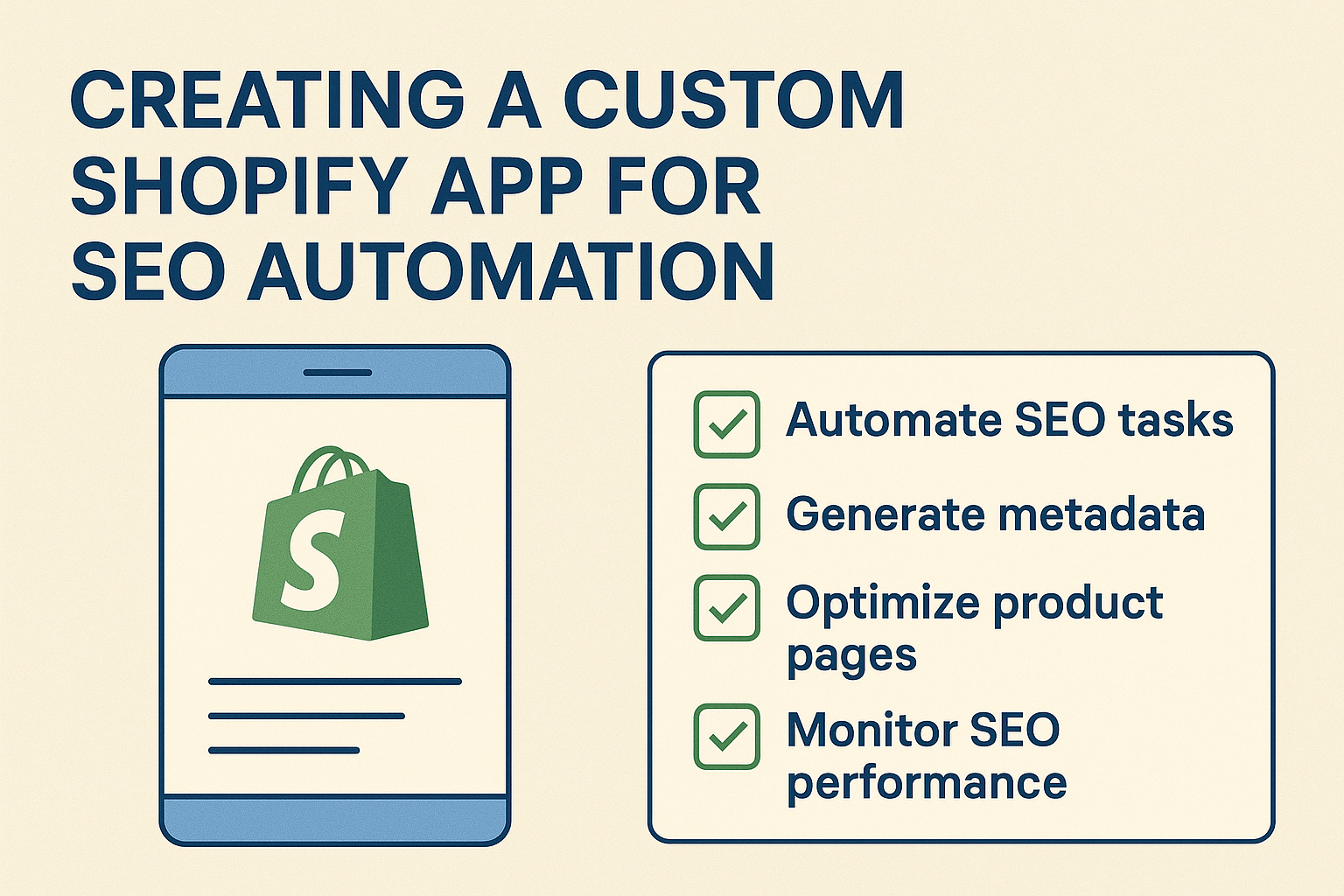
Start with essential features that provide immediate value—automated meta tag generation, internal linking optimization, and basic technical SEO monitoring. These foundational elements establish your app’s core value while providing measurable improvements you can build upon.
Focus on creating robust error handling and rollback capabilities. SEO automation mistakes can be costly, so your initial version should include safeguards against over-optimization, duplicate content generation, and accidental bulk changes that might harm existing rankings.
Phase 3: Advanced Feature Implementation
Once core functionality proves reliable, expand into sophisticated features like predictive keyword research, competitor monitoring, and dynamic content optimization. These advanced capabilities differentiate custom solutions from standard SEO tools, providing competitive advantages that justify development investments.
Implement machine learning elements that improve optimization accuracy over time, learning from your store’s performance data to make increasingly effective automated decisions.
Measuring Success: KPIs That Matter for SEO Automation
Traffic Quality and Conversion Metrics
Track organic traffic growth alongside conversion rates to ensure automation improves business outcomes, not just vanity metrics. Monitor average session duration, pages per session, and bounce rates across different traffic segments to verify that automated optimizations attract qualified visitors.
Your custom app should correlate SEO improvements with revenue impact, tracking which automated optimizations generate the highest ROI. This data guides future development priorities and justifies continued investment in custom solutions.
Time Savings and Operational Efficiency
Document time savings from automated processes, measuring both direct task automation and indirect benefits like reduced error correction and faster implementation of optimization strategies. Calculate the hourly value of time saved and compare against development and maintenance costs.
Track consistency metrics showing how automation maintains SEO standards during busy periods, seasonal rushes, or staff transitions when manual optimization typically suffers.
Competitive Position and Market Share
Monitor your search rankings for target keywords relative to competitors, focusing on trend improvements rather than absolute positions. Custom SEO automation should help you respond faster to market changes, maintaining or improving competitive positioning despite increased market competition.
Common Pitfalls and How to Avoid Them
Over-Automation Without Strategic Oversight
The biggest mistake in SEO automation involves removing human judgment entirely from strategic decisions. While custom apps excel at implementing optimizations consistently, they need human oversight for strategic direction, competitive positioning, and brand voice maintenance.
Establish clear boundaries between automated tasks and activities requiring human expertise. Your app should handle repetitive implementation while alerting you to strategic opportunities or significant market changes requiring manual evaluation.
Ignoring Content Quality for Optimization Quantity
Automated content generation can produce technically optimized but low-quality content that damages user experience and long-term SEO performance. Design your custom app with quality controls that prioritize user value alongside search engine optimization.
Implement content quality metrics and user engagement monitoring to ensure automated optimizations improve rather than compromise content effectiveness.
Future-Proofing Your Custom SEO Automation
Adapting to Algorithm Updates and Industry Changes
Design your custom app architecture to accommodate search engine algorithm updates without requiring complete rebuilds. Use modular development approaches that allow rapid adjustments to optimization strategies as search engine requirements evolve.
Stay connected with SEO industry developments through automated monitoring of official search engine communications, ensuring your app adapts to new requirements before they impact your store’s performance.
Scaling Automation as Your Business Grows
Plan for business growth by designing scalable automation workflows that maintain effectiveness as your product catalog, traffic volume, and market complexity increase. Consider how your current automation approach will perform with 10x traffic or 100x product inventory.
Build flexible rule engines that accommodate new business models, market expansion, or product line diversification without requiring fundamental app redesigns.
Taking Action: Your Next Steps Toward SEO Automation
Creating a custom Shopify SEO app represents a significant investment in your store’s long-term success, but the returns justify the effort for serious e-commerce businesses. Start by documenting your current SEO processes, identifying high-impact automation opportunities, and setting realistic development timelines.
Consider partnering with experienced developers who understand both Shopify’s technical requirements and SEO best practices. The intersection of e-commerce development and search optimization requires specialized expertise that generic app developers might lack.
Remember that successful SEO automation evolves gradually rather than launching as a complete solution immediately. Begin with core functionalities that provide measurable improvements, then expand capabilities based on performance data and business growth.
Your custom Shopify SEO app should become a competitive advantage that adapts to your business needs while maintaining the optimization consistency that drives long-term organic growth. The stores winning in competitive e-commerce markets aren’t necessarily those with the biggest budgets—they’re the ones with the smartest automation strategies that scale human expertise through intelligent technology.
The question isn’t whether you can afford to build custom SEO automation—it’s whether you can afford to keep optimizing manually while your automated competitors pull further ahead in search rankings and market share.