

You’ve built a stunning Shopify store, uploaded perfect product photos, and crafted compelling descriptions. But after months of effort, your traffic remains frustratingly low. Sound familiar? Here’s the truth most store owners miss—beautiful storefronts mean nothing if search engines can’t properly crawl, understand, and rank your website.
This is where technical SEO becomes your secret weapon. While Shopify SEO focuses on optimizing your entire e-commerce presence, technical SEO specifically handles the foundation that makes everything else possible. Think of it as the electrical wiring in your house—invisible to guests but absolutely critical for everything to function.
After working with hundreds of Shopify stores over 8 years, I’ve seen how proper technical optimization can transform struggling businesses into traffic magnets. Let’s dive into exactly what technical SEO means for your Shopify store and why it’s the game-changer you’ve been missing.
What Exactly Is Technical SEO and Why Should Shopify Store Owners Care?
Technical SEO encompasses all the behind-the-scenes optimizations that help search engines crawl, index, and understand your website effectively. Unlike content marketing or link building, technical SEO focuses on your website’s infrastructure, speed, mobile-friendliness, and overall user experience signals.
For Shopify store owners, this becomes even more critical because e-commerce sites face unique challenges. You’re dealing with thousands of product pages, complex category structures, inventory changes, and checkout processes that need to work flawlessly for both users and search engines.
Consider this: Google processes over 8.5 billion searches daily, and 53% of users abandon websites that take longer than 3 seconds to load. When your technical foundation is solid, you’re not just improving search rankings—you’re directly impacting sales conversions and customer satisfaction.
The difference between stores that thrive and those that struggle often comes down to technical implementation. A well-optimized Shopify store can see 40-60% improvements in organic traffic within 3-6 months of proper technical optimization.
How Do Search Engines Actually Interact With Your Shopify Store?
Understanding how search engines “see” your Shopify store is crucial for technical optimization success. When Google’s crawlers visit your website, they’re essentially reading your site’s code, following internal links, and trying to understand your content structure and relevance.
Here’s what happens during a typical crawl of your Shopify store: Google’s bots arrive at your homepage, scan your navigation menu, follow product category links, crawl individual product pages, and attempt to understand relationships between different pages. They’re also evaluating page loading speeds, mobile responsiveness, and overall user experience signals.
The challenge with Shopify stores is complexity. You might have 500 products across 20 categories, with seasonal inventory changes, sale pages, and blog content. Search engines need clear signals about what’s important, what’s changed, and how everything connects together.
This is where technical SEO Services become invaluable. Professional optimization ensures your site architecture guides crawlers efficiently, preventing wasted crawl budget on unimportant pages while prioritizing your money-making product and category pages.
What Are the Core Technical SEO Elements Every Shopify Store Needs?
Site Speed and Core Web Vitals Optimization
Page speed directly impacts both search rankings and sales conversions. Google’s Core Web Vitals measure three key performance metrics: Largest Contentful Paint (loading performance), First Input Delay (interactivity), and Cumulative Layout Shift (visual stability).
For Shopify stores, common speed issues include oversized product images, excessive app installations, and unoptimized themes. A clothing retailer I worked with reduced their homepage load time from 6.2 seconds to 2.1 seconds by optimizing images and removing redundant apps, resulting in a 34% increase in organic traffic and 28% boost in conversion rates.
Action Points for Speed Optimization:
- Compress all product images to under 100KB without quality loss
- Limit third-party apps to essential ones only
- Use Shopify’s native lazy loading for images
- Implement browser caching through your theme settings
- Choose lightweight, speed-optimized themes
Mobile-First Indexing and Responsive Design
With over 60% of e-commerce traffic coming from mobile devices, Google now uses mobile-first indexing, meaning they primarily use your mobile site version for ranking decisions. Your Shopify store must deliver exceptional mobile experiences to compete effectively.
Common mobile issues include tiny text, difficult navigation, slow mobile loading times, and checkout processes that frustrate mobile users. These problems don’t just hurt SEO—they directly impact sales since mobile users are often ready-to-buy customers.
XML Sitemaps and Site Architecture
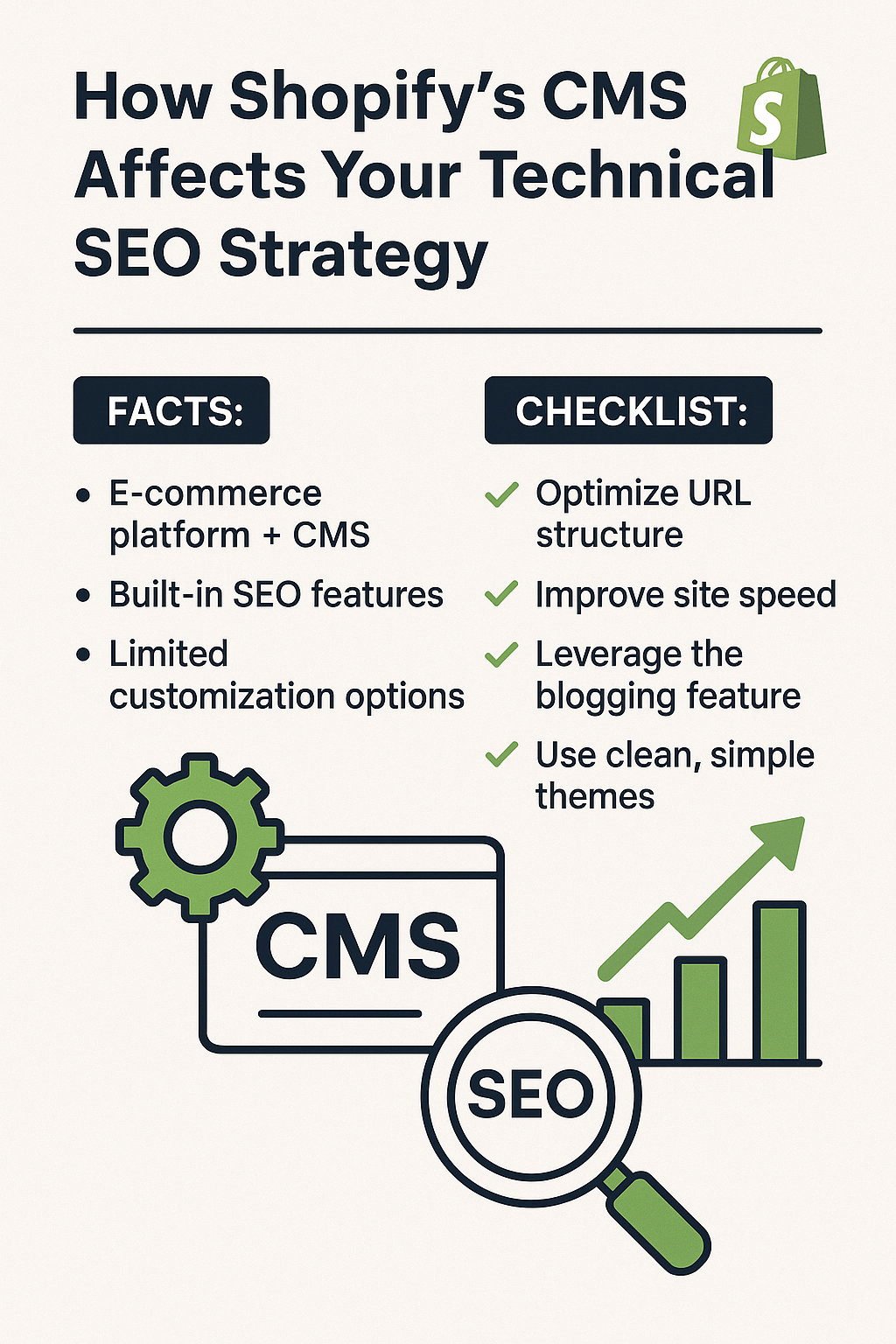
Your Shopify store’s sitemap acts as a roadmap for search engines, telling them about all your important pages and how often they’re updated. Shopify automatically generates basic sitemaps, but optimization is crucial for larger stores with complex product catalogs.
Effective site architecture for Shopify stores follows a logical hierarchy: Homepage connects to main category pages, categories lead to subcategories when needed, and product pages link back to relevant categories. This structure helps search engines understand your store’s organization and passes authority effectively throughout your site.
How Can You Identify and Fix Technical SEO Issues in Your Shopify Store?
Conducting a Comprehensive SEO Audit
A thorough SEO Audit reveals exactly what’s preventing your Shopify store from reaching its traffic potential. Professional audits examine site speed, crawlability, indexation issues, duplicate content problems, and mobile usability concerns.
Start with Google Search Console to identify crawl errors, indexing issues, and mobile usability problems. Use tools like Google PageSpeed Insights to analyze Core Web Vitals performance. Check for duplicate content issues, especially common with product variants and filtered pages.
For comprehensive analysis, professional Ecommerce SEO audits dive deeper into technical issues specific to online stores, including product schema markup, internal linking optimization, and conversion funnel analysis.
Fixing Common Shopify Technical Issues
Duplicate content represents one of the biggest technical challenges for Shopify stores. Product variants, filtered collection pages, and similar product descriptions can create multiple URLs with identical content, confusing search engines about which pages to rank.
Implement canonical tags to specify preferred versions of similar pages. Use proper URL parameters handling for filtered collections. Create unique, valuable content for each product page rather than relying on manufacturer descriptions that appear on dozens of other websites.
Action Points for Technical Fixes:
- Set up proper 301 redirects for discontinued products
- Implement structured data markup for products and reviews
- Optimize your robots.txt file to guide crawler behavior
- Fix broken internal links and 404 errors regularly
- Ensure proper HTTPS implementation across all pages
Why Does Local SEO Matter for Shopify Store Owners?
Even if you’re running a primarily online business, Local SEO can significantly impact your Shopify store’s success, especially if you serve specific geographic markets or have physical locations supporting your online presence.
Local SEO becomes particularly important for Shopify stores in competitive niches. A handmade jewelry store targeting customers in specific cities can use local optimization to compete against larger national retailers by dominating local search results.
Implement local schema markup if you have physical locations, optimize your Google Business Profile, and create location-specific content when relevant. Even purely online stores can benefit from local SEO by targeting “near me” searches and location-based keywords in their content strategy.
What Role Does On-Page SEO Play in Technical Optimization?
On Page SEO and technical SEO work hand-in-hand to create comprehensive optimization strategies. While technical SEO handles the infrastructure, on-page optimization ensures your content is properly structured and optimized for both users and search engines.
For Shopify stores, this means optimizing product titles, descriptions, and meta tags while ensuring proper heading tag hierarchy, internal linking strategies, and image alt text optimization. Each product page should target specific keywords while maintaining natural, helpful content that encourages purchases.
Semantic SEO becomes increasingly important as search engines better understand context and user intent. Instead of keyword stuffing, focus on creating comprehensive content that covers topics thoroughly and answers common customer questions.
Action Points for On-Page Optimization:
- Write unique, detailed product descriptions targeting long-tail keywords
- Optimize title tags to include primary keywords and brand names
- Create compelling meta descriptions that encourage clicks
- Use proper heading tag structure (H1, H2, H3) throughout your content
- Implement internal linking strategies that guide users and search engines
How Can You Measure Technical SEO Success for Your Shopify Store?
Measuring technical SEO improvements requires tracking multiple metrics that indicate both search engine and user satisfaction. Key performance indicators include organic traffic growth, search engine rankings for target keywords, page loading speeds, and conversion rate improvements.
Google Search Console provides essential data about your site’s search performance, including impressions, clicks, average position, and technical issues. Monitor Core Web Vitals scores through PageSpeed Insights and track improvements over time.
Set up conversion tracking to measure how technical improvements impact actual sales. A 2-second reduction in page load time might increase your conversion rate by 1-3%, directly impacting revenue alongside SEO benefits.
Action Points for Measurement:
- Set up Google Analytics 4 with enhanced e-commerce tracking
- Monitor Google Search Console weekly for new issues
- Track Core Web Vitals scores monthly
- Measure organic traffic growth and keyword ranking improvements
- Analyze conversion rate changes following technical optimizations
What’s Next for Your Shopify Store’s Technical SEO Journey?
Technical SEO isn’t a one-time project—it’s an ongoing process that requires regular attention and updates. As your Shopify store grows, adds new products, and evolves with changing customer needs, your technical optimization strategy must adapt accordingly.
Start with the foundational elements: ensure your site loads quickly, works perfectly on mobile devices, and provides clear navigation for both users and search engines. Focus on fixing the most impactful issues first, such as site speed problems and crawlability issues, before moving to advanced optimizations.
Remember that technical SEO supports all your other marketing efforts. When your foundation is solid, your content marketing performs better, your paid advertising converts more effectively, and your social media traffic engages more deeply with your store.
The investment in proper technical SEO pays dividends across your entire digital marketing strategy. Stores that prioritize technical optimization consistently outperform competitors who focus solely on content and links while ignoring their website’s underlying performance issues.
Ready to transform your Shopify store’s technical performance? Start with a comprehensive audit to identify your biggest opportunities, then systematically address each issue while monitoring your progress. Your future self—and your bank account—will thank you for building this solid foundation today.